Wingbox Pull Request Check
A pull request shows the lines that changed. This check turns them into a review plan: which function or type changed, which modules outside the pull request use it, and which tests to run. One comment for the reviewer, the same plan as a file for a reviewing agent. Computed on your runner without a language model.
Install from the GitHub MarketplaceOn a live pull request
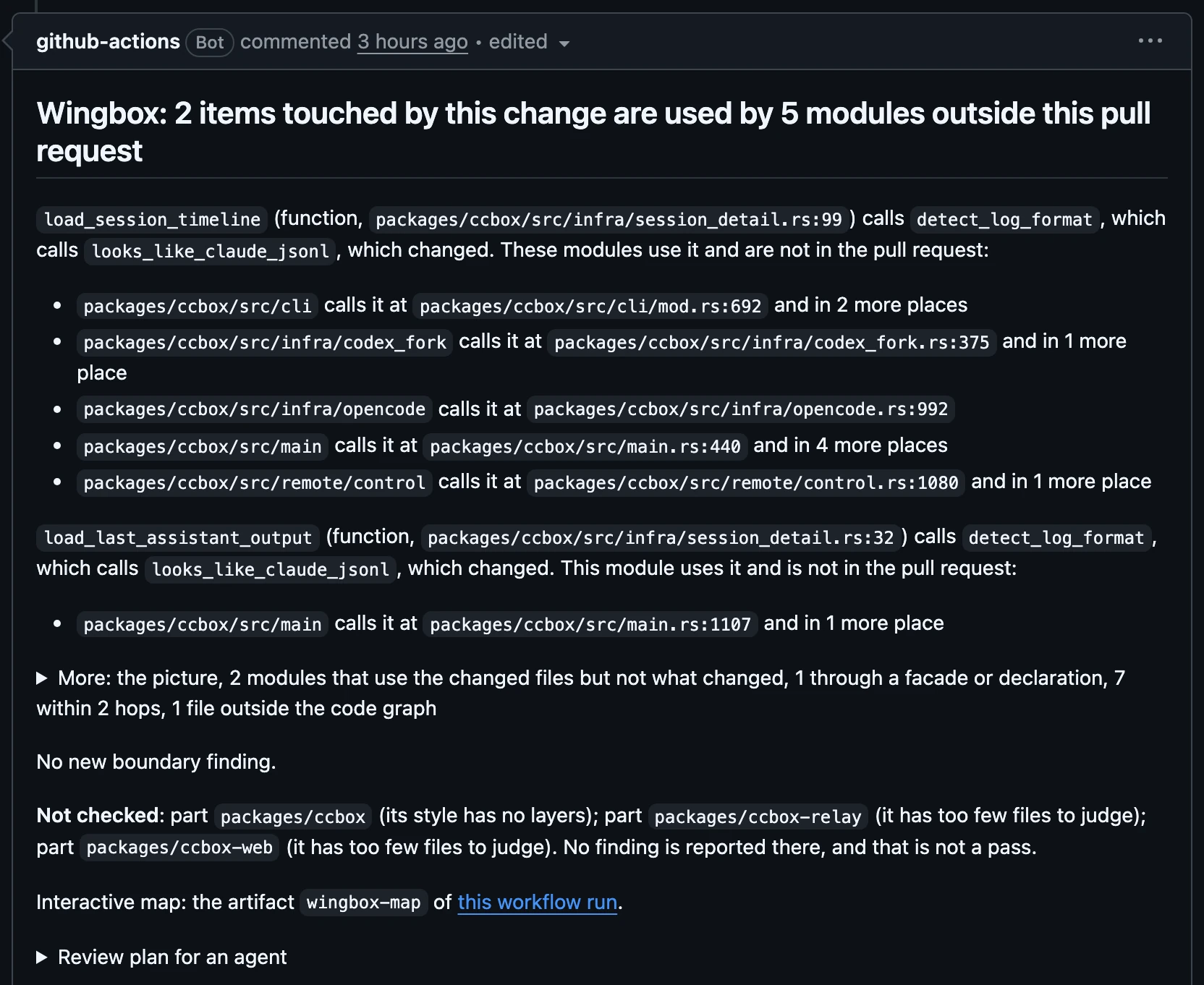
This pull request changes one line inside a private function. The comment names the two public functions that call it, and every module that calls those, with the file and the line of each call.
 Open the pull request on GitHub
How to read the comment
The heading
How many functions or types the change touches, and how many modules outside the pull request use them. Those modules are not in the diff, so a reviewer would not see them.
"X calls Y, which changed"
The change is inside Y. X is a function other modules use, and it calls Y in the same file. So the change reaches everyone who calls X.
The rows
Each module that uses the item: whether it calls it, imports it or uses it as a type, and where.
Tests that use what changed
The test files to run, by name. When a test changes together with the code it tests, the comment says so: look at what the test no longer checks.
One sentence
When the change is a comment, a test, or something no other module uses, the comment says so in one line and lists nothing.
New boundary findings
When the pull request adds an import that crosses a layer rule of your architecture, that finding leads the comment.
More
Folded under one line: a diagram of the modules around the change, the modules farther away, the tests, and the parts of the repository that could not be checked, said as such.
The same plan, for a reviewing agent
An agent that reviews a pull request usually gets the diff and searches the repository for what it touches. The check hands it the list instead: every place to open with the file and the line, every test to run, and what could not be checked. The plan is in a folded block of the comment and in a file on the runner (the output plan).
(review-plan :schema 1 :result UNKNOWN :execution ok :base 70939f6 :head cf6d8c8 :wingbox "0.11.0" :hops 2)
(reason "not-checked: . (no-layer-style)")
(changed-item "src/infra/session_detail.rs" load_session_timeline :kind fn :line 97 :how calls :via (detect_log_format looks_like_claude_jsonl))
(look "src/cli/mod.rs" 331 :module src/cli :why call :item load_session_timeline :places 2)
(look "src/infra/opencode.rs" 992 :module src/infra/opencode :why call :item load_session_timeline :places 1)
(look "src/main.rs" 426 :module src/main :why call :item load_session_timeline :places 5)
(not-checked "." :reason no-layer-style)
- look
- A place outside the pull request that uses what changed. Open it.
- run-test
- A test that uses what changed. Run it.
- changed-item ... :via
- The item calls the listed functions, and the last one is where the change is.
- not-checked
- A part of the repository the boundary rules could not be checked on.
A result that never reads "not checked" as "passed"
The check of the architecture rules ends in one of four results, given as an output of the action. Set fail-on: strict and the job fails on everything but a pass. In the example above the result is UNKNOWN: that repository has no layer rules to check, and the check says so instead of passing.
The pull request adds an import or a call that crosses a rule, also one that only its own edit of the rules or of the baseline would accept.
A part of the repository was not checked, files of a language were left out, the files checked are not the commit the report names, or the tool ended abnormally. Never shown as a pass.
No source file outside the tests changed.
Everything was checked and nothing new crosses a rule.
Evidence that the tests ran
The check names the tests that use what changed; it never runs them. When the job runs its tests first and they write JUnit XML reports, hand the reports over: each test in the plan then says what the reports hold about it.
      - id: tests
        run: python -P -m pytest --junitxml=test-results/junit.xml
        continue-on-error: true      # failing tests must not end the job before the check
      - uses: aileron-tech/wingbox-action@v1
        if: ${{ !cancelled() }}
        with:
          test-results: test-results/*.xml
          test-step-outcome: ${{ steps.tests.outcome }}
          require-tests: true     # optional: fail unless every test that uses what changed has a passed record
      - if: ${{ steps.tests.outcome != 'success' }}
run: exit 1 # the job fails when the tests didEach test that uses what changed carries what the reports hold about every one of its cases: passed, failed, partial (one case passed, another was skipped or did not run), skipped or no-record. Only passed counts as passed. When no test uses what changed, the test evidence is none-found, never complete.
A report is refused, and counts as no evidence, when git tracks it, when it is older than the run, or when it names another commit. A report of this run is written by the test step, not committed.
A manifest in the repository, .wingbox/required-tests.yaml, says which tests a change of which paths must pass, whatever the graph finds. It is read from the base commit, so a change cannot drop a requirement it is judged by.
When a pull request edits the rules or the baseline, its findings are judged with those files as the base has them. A new baseline entry needs an owner, a reason and an end date. With fail-on: strict, a pull request that edits such a file fails the job.
The report names the commit whose files it read, and the SHA-256 of each changed file in that commit. When the checkout is another commit, or holds changed files, the result is UNKNOWN.
Every run writes one JSON record, also when the test step fails or the check itself could not run. It keeps the verdicts apart (introduced, there before, baseline, tests, coverage), says what the run analysed and what it left out, and whether the record is eligible as evidence. Its schema, version 2, is in the repository.
Inputs: test-results, test-step-outcome, require-tests, required-tests, test-command, policy-change. Outputs: evidence, eligible, coverage-complete, tests-evidence, tests-passed, tests-failed, tests-without-record, test-reports-refused, policy-changed.
All inputs and outputsFor a team that prepares for an audit: what a run gives as evidence, and where it stops; the three modules.
Add it to a repository
One workflow file. No account, no API key, no configuration.
name: wingbox
on: pull_request
permissions:
  contents: read
  pull-requests: write
jobs:
  check:
    runs-on: ubuntu-latest
    steps:
      - uses: actions/checkout@v4
        with:
          fetch-depth: 0
      - uses: aileron-tech/wingbox-action@v1
uses: aileron-tech/wingbox-action@v1In GitLab CI
The same check for merge requests and for pushes to the default branch, on GitLab.com or your own instance. One include line. The report goes to the job log and to artifacts; with a project access token it is also one note on the merge request, updated on each push.
Runners with the Docker or Kubernetes executor
include:
  - remote: "https://raw.githubusercontent.com/aileron-tech/wingbox-action/v1/gitlab/wingbox.gitlab-ci.yml"
Runners with the shell executor
include:
  - remote: "https://raw.githubusercontent.com/aileron-tech/wingbox-action/v1/gitlab/wingbox-shell.gitlab-ci.yml"
A shell runner runs the commands on its own machine, with whatever Python that machine has. This job runs the check in a container instead: your checkout is mounted read-only, and the only folder written on the runner is wingbox-out/.
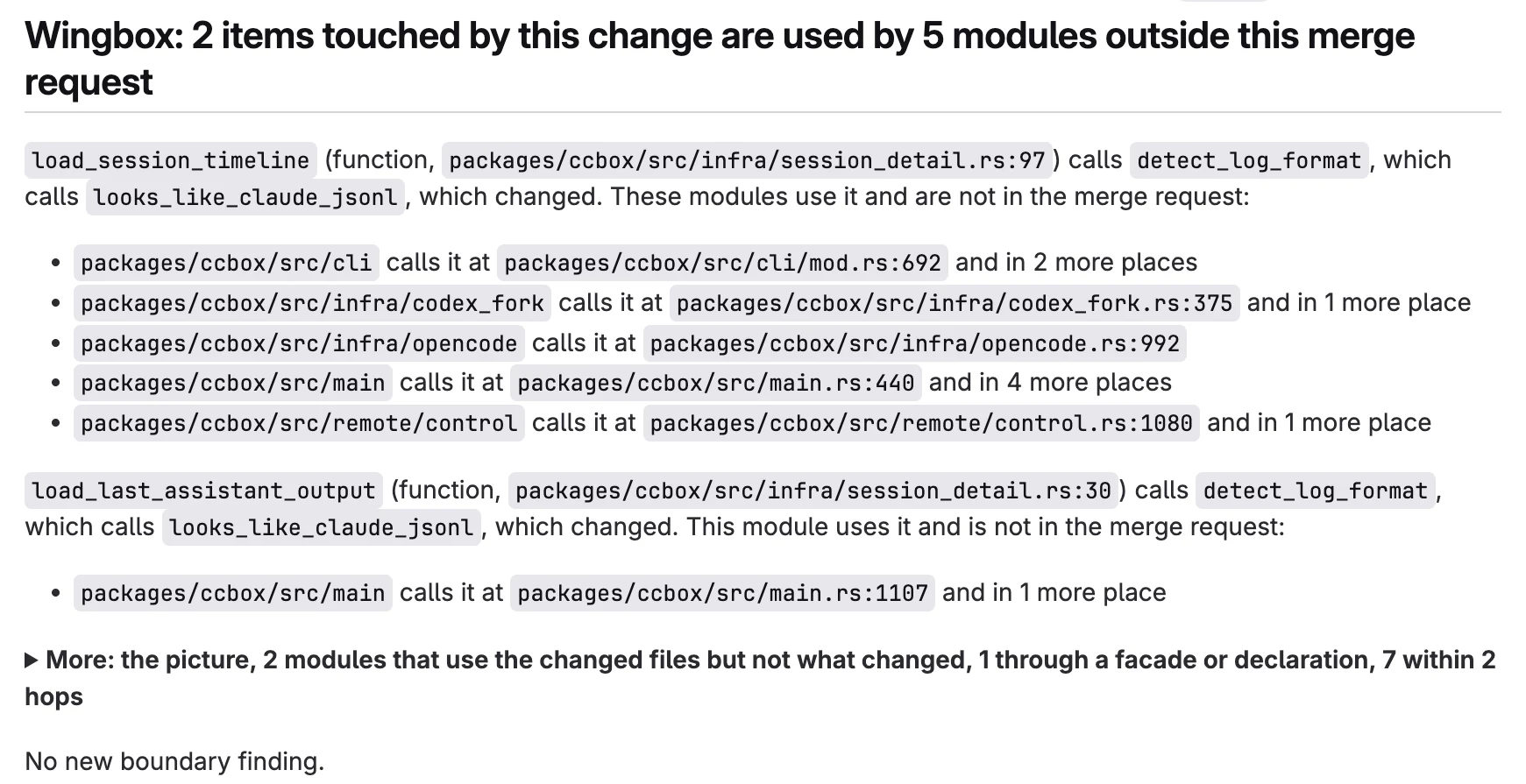
Merge request
The merge request's diff base against its head commit.
Push to the default branch
The commit before the push against the pushed commit. For teams that push without a merge request.
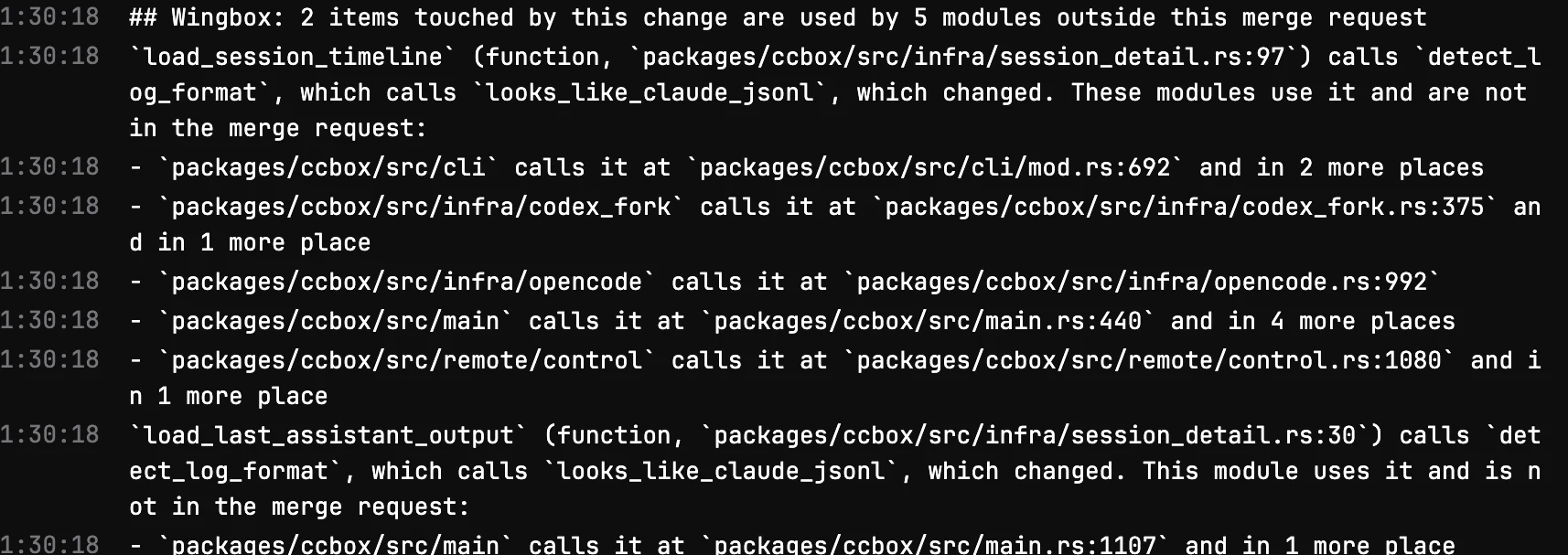
What the job leaves
- wingbox-out/wingbox-report.md
- The full report.
- wingbox-out/wingbox-plan.sexp
- The review plan for an agent: the places to open and the tests to run.
- wingbox-out/wingbox-evidence.json
- The evidence record of the run, as JSON.
- WINGBOX_RESULT and six more variables
- PASS, FAIL, UNKNOWN or NOT_APPLICABLE, the reasons and the counts, handed to the later jobs of the pipeline.
- One note on the merge request
- When the masked CI/CD variable WINGBOX_GITLAB_TOKEN holds a project access token with the api scope. Without it nothing is posted.
WINGBOX_RESULT=UNKNOWN
WINGBOX_EXECUTION=ok
WINGBOX_REASONS="not-checked: packages/ccbox (no-layer-style); ..."
WINGBOX_UNTOUCHED_DEPENDENTS=15
WINGBOX_INTRODUCED_FINDINGS=0
WINGBOX_NOT_CHECKED_PARTS=3
WINGBOX_TESTS_TO_RUN=0
wingbox:
  variables:
    WINGBOX_FAIL_ON: "strict"     # none (default), violations, not-checked, strict or existing
    WINGBOX_VERSION: "0.14.0"     # the wingbox release from PyPI
    WINGBOX_ACTION_REF: "v1"      # a tag, a branch or a commit of wingbox-action
To pin everything, put a commit in both places: in the address of the include and in WINGBOX_ACTION_REF.
All settings for GitLab CIWhat it never does
No language model
The comment is computed: parsers build a graph of the code and the report is read from it. The same pull request gives the same comment.
No code leaves the runner
The graph is built and queried on your own GitHub or GitLab runner. The comment holds module names, file paths and item names; no source lines.
Nothing is written to your repository
No commit, no push, no file in your branch.